B&K Chino Concrete CompanyB&K Chino Concrete Company(909) 479-6302

Concrete Contractor in Ontario, CA - Driveways and Slabs Built on a Solid Base

B&K Chino Concrete Company is a concrete contractor based in Chino. We build driveways, patios, walkways, garage floors, footings and slabs for homeowners, property owners and builders in Ontario, CA.

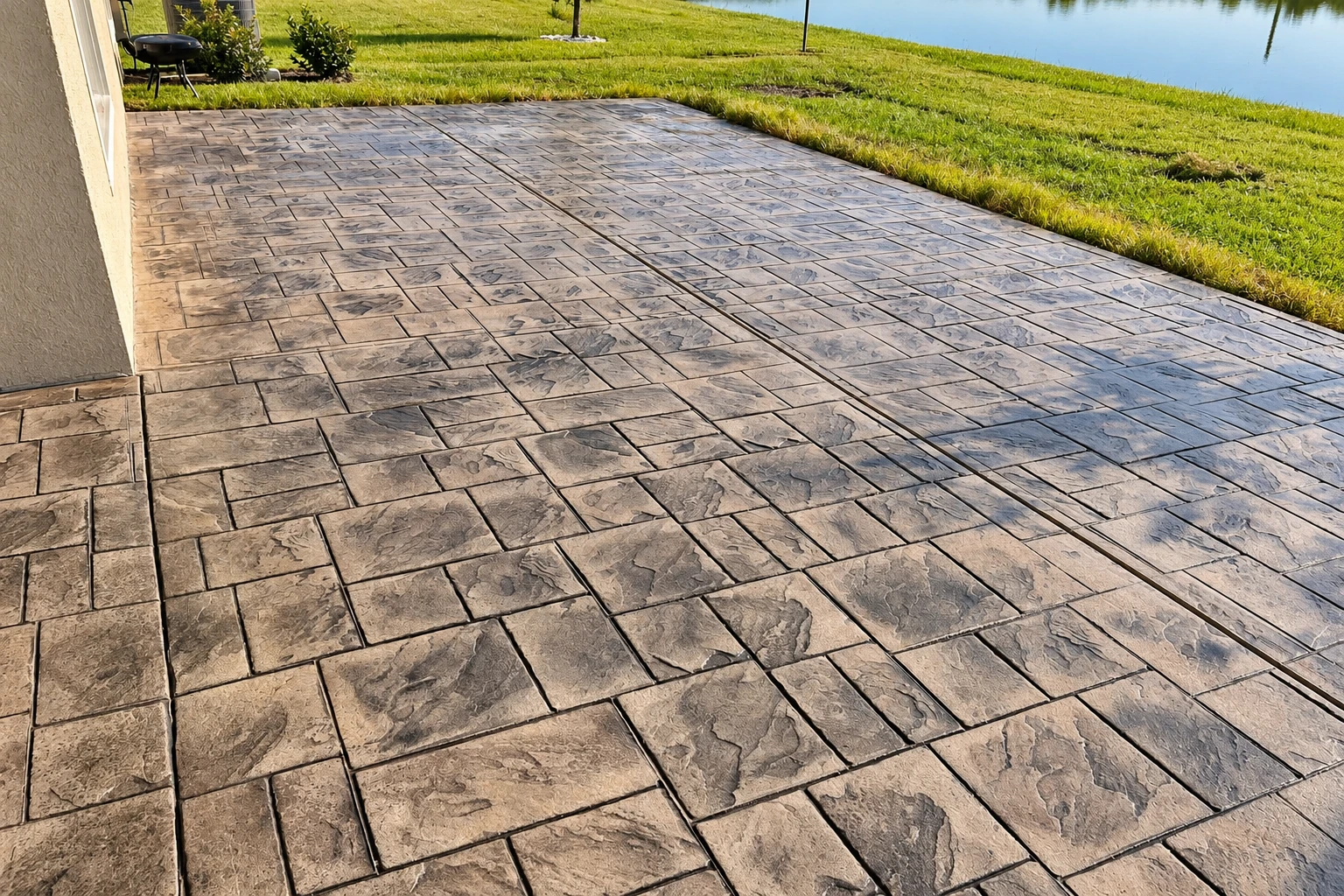
Tan stamped concrete patio features a repeating rectangular stone pattern beside a grassy lawn and pond.

What concrete work in Ontario usually looks like

Ontario is right next door to Chino, so it's a short drive for our crew, and the calls here sound a lot like the ones we get at home. Homeowners want a cracked driveway replaced, a patio poured where the lawn gave up, or a garage floor that won't stop chipping. Property owners and builders call about footings, slabs and parking lots. We do the same work just west in Pomona and north in Upland.

Ontario has older houses with their original driveways and newer homes too, and the age of the house usually tells me a lot before anything comes up. An older slab often sits on ground that's had decades to settle, and we won't know how much base it needs until the old concrete is out.

Concrete services we offer in Ontario

Every service we offer in Chino we also bring to Ontario, from driveways, patios and walkways to garage floors, footings, slabs and parking lots. We plan each job around two things, what the ground under it is doing and what the slab has to carry. A patio table and a work truck need very different things underneath. That's why we look at the job before we put a price on it, and why the base gets as much attention as the finish.

  • Concrete driveway building

    Older driveways usually crack and sink because their base was never dug out and packed. We tear out the old slab, fix what's under it and pour one sized for what you park.

    Explore service
  • Concrete patio construction

    People usually call because the backyard is bare dirt or the patio holds water by the back door. We set the slab to drain away from the house before we pour.

    Explore service
  • Stamped concrete services

    Stamping presses a stone or brick pattern into wet concrete for patios and walkways that need more than plain gray. We prep the base like any slab, because a pattern won't hide settling.

    Explore service
  • Concrete sidewalk building

    Walkways get lifted by roots or sunk by sprinkler runoff until an edge catches your toe. We replace the bad sections and give the new ones a broom finish, a light texture for grip.

    Explore service
  • Garage floor concrete

    A cracked, chipping or oil-soaked garage floor usually needs more than a coating. We break out what's failed, fix the base and pour a new floor that drains toward the door.

    Explore service
  • Decorative concrete

    Front entries and yards that should look like more than a slab get color, borders or exposed stone. The look is the easy part, so most of our time goes into the ground underneath.

    Explore service
  • Concrete retaining walls

    Where a yard steps down or a slope slides onto the patio, a retaining wall holds the dirt back. We build in drainage behind it, because trapped water is what pushes walls over.

    Explore service
  • Concrete floor installation

    Shops, sheds, additions and commercial spaces need an interior floor that sits flat and level for what goes on it. We set the base and the steel to match the load before pouring.

    Explore service
  • Concrete pool decks

    Pool decks take splashing, bare feet and constant water, so slick or cracked concrete around a pool is a real problem. We slope the deck away from the water and finish it for grip.

    Explore service
  • Concrete steps construction

    Front and back steps crack and pull away from the house as the ground under them settles. We dig out, set steel and form the risers so the steps come out even.

    Explore service
  • Slab foundation building

    Additions, garages, backyard units and new builds start with a slab, and everything above it depends on that slab. We dig, compact and set steel to the plans before the pour.

    Explore service
  • Foundation installation

    Starting a structure from bare ground means building a foundation to the plans and getting it ready for inspection. We form, set steel and pour to those plans, and the inspection is booked before the pour.

    Explore service
  • Concrete parking lot building

    Business and apartment lots carry heavy traffic, and a cracked or ponding lot is a headache for the owner. We plan thickness, drainage and joints for the trucks it has to take.

    Explore service
  • Concrete footings

    Patio covers, block walls, decks and additions sit on footings, the concrete pads that carry the weight into the ground. We dig them to the depth the plans call for.

    Explore service
  • Foundation raising

    When part of a house has settled and doors start sticking, the low section may need raising. I look at it first and bring in an engineer when the job calls for one.

    Explore service
  • Concrete cutting

    Widening a driveway, adding a doorway or reaching a buried line often means cutting existing concrete. We saw-cut straight lines and call a scanning company if pipes or wires might be hidden in the slab.

    Explore service

Working in Ontario: permits, licenses, price and timing

Ontario has its own building office and its own business license rules, separate from Chino's. Here's how those rules and the slab itself shape the plan, the price and the timing of your job.

Permits and licenses for concrete work here

Permits in Ontario come from the city's Building Department, which reviews plans and inspects the work. That office decides whether your job needs a permit, and when it isn't clear, we ask them before anything starts. If it does need one, we work out with you who pulls it and build the schedule around the city's inspections, because those set the pace more than we do.

Before you hire anyone, ask two questions. Does the contractor hold a current state contractor's license, and do they have an Ontario business license? The city requires a business license before any business starts work here, and that includes contractors from other cities, so a crew from Chino or anywhere else needs one too. I'd rather you ask than assume.

  • Plan review comes before work starts, so allow for it in your timeline.
  • Ask any contractor for a current state license before you sign anything.
  • Contractors from other cities need an Ontario business license, not just their own.

What moves your price and your schedule

Size matters, but the bigger price questions are usually under and around the slab. Several things move the number. How much old concrete comes out, how much base has to be dug and packed, whether the grade needs reshaping so water runs away from the house, and whether a truck can reach the forms or we're wheeling concrete through a side yard.

The schedule depends on permits and inspections when a job needs them, on how much old concrete comes out first, and on curing. That's the wait while new concrete hardens enough to take weight. You'll walk on a new patio well before you park on a new driveway. I give you your price when I come out and see the job, because I can't price a base I haven't looked at.

  • Stamping, color or exposed stone costs more than a plain broom finish.
  • Rebar, the steel grid inside a slab, adds cost and holds cracks tight.
  • Slab thickness goes up with what it carries, and so does the price.

Get a free on-site concrete estimate in Ontario

Send the form or call (909) 479-6302, and we'll get back to you within one business day to set a time. I'll come out to your Ontario property myself, look at the job and the ground under it, and give you a free estimate with no obligation to hire us.

(909) 479-6302

What we run into on Ontario driveways and yards

Most concrete problems we see around here start under the slab or next to it, not in the concrete itself. These are the ones we look for first when we walk a property.

  • Cracks that grow or step up

    A crack that keeps widening, or one side that's dropped below the other, usually means the ground under the slab moved. Patching the top won't stop that. We find out why it moved first, and if the base is the problem, the honest fix is a new slab on a new base.

  • Water pooling by the house

    Pooling water at the back door, or a patio that tips toward the house, is one of the most common things we're called about. Each time the sprinklers run, water soaks the ground under the slab and against the foundation. That's why we check which way the lot drains before we set a form.

  • Roots under walkways and drives

    Tree roots lift walkways and driveway edges a little each year until a section turns into a trip hazard. Grinding the edge buys time, but if the root is still growing, the section comes back up. We look at where the tree is before deciding whether to replace the section or move the walk.

  • Driveways carrying more than planned

    Plenty of driveways built for a sedan now hold work trucks, trailers and RVs. A thin slab on a weak base breaks at the edges and under the tires first. Tell us what parks there, and we'll set the thickness, base and steel for that load instead of guessing.

  • Additions and backyard structures

    Additions, garages, patio covers and backyard units all start with footings or a slab, and the concrete has to match the plans before anything goes on top. We pour to the drawings the builder or engineer provides and check the forms against them before the truck shows up.

How we handle concrete work in Ontario

Plenty of crews pour concrete in Ontario. Here's how we work, starting with the part of the job you won't see once the concrete is down.

The base gets the work you can't see

Most bad concrete I've torn out failed because of what was under it or how it was finished, not the mix. The subgrade, the packed ground and base the slab sits on, is buried the day we pour. So it's the first place a tight budget wants to save money, and it's the last place I'll let that happen.

So we dig out to firm ground instead of raking old dirt level, pack new base, and set the grade so water runs away from your house, not toward it. If money's tight, I'll pour a plain broom finish on a good base before I'll pour a stamped one on a bad base, because a pretty slab that sinks is still a slab that sinks.

  • I look at every job myself

    I come out to look at every Ontario job myself, and my crew and I do the work, so the person who priced it is the person who pours it. I started the business in Chino in 2021 after years on other crews, because I wanted the work done the way I was taught.

  • Joints cut where cracks belong

    Concrete cracks, and anyone who says yours won't is selling something. Control joints are grooves we cut into the new slab, and they give it a line to crack along instead of across the middle. We cut them on time and pour early in the day, because concrete that dries too fast gets a weak, dusty top.

  • Licensed, insured and guaranteed

    We're licensed and insured, and you're welcome to check before you sign anything, the same as you'd check any contractor working on your house. Our promise is satisfaction guaranteed on every job, and it's the same in Ontario as it is in Chino.

  • The honest answer, even if smaller

    When a cracked section can be cut out and replaced, I'd rather tell you that than sell you a whole new driveway, even if it means a smaller job. If you want a straight answer on your Ontario job, call (909) 479-6302 or send the form.

Ontario questions about permits, licenses and payments

These are the paperwork questions that come up before a concrete job in Ontario. The answers come from what the city and the state require of homeowners and contractors.

How do I know if my concrete job in Ontario needs a licensed contractor?

If the job needs a building permit, uses hired workers, or comes to $1,000 or more for labor and materials together, California requires a current license from the Contractors State License Board. The only exception is a small job with no permit, no employees and all costs under $1,000. The board doesn't allow splitting a bigger job into small contracts to get under that line.

How much of a down payment can a contractor ask for in California?

Under the state board's guidance, a down payment can be no more than $1,000 or 10 percent of the total contract price, whichever is less. Later payments are spelled out in the contract and tied to work done or materials delivered. The rule covers all home improvement projects, and concrete work is included.

How do I find out if my concrete project in Ontario needs a permit?

Call the city's building office at (909) 395-2023 and describe the job. If you'd rather go to the counter, it closes for staff meetings on Tuesdays from 7:30 to 9:00 am and on the first Thursday of each month from 8:00 to 10:00 am.

Does Ontario charge a fee to extend a building permit?

Yes, the city charges for every extension after the first one. The first extension request on a plan check or permit is free, and each extension granted after that costs $150 on a residential permit and $300 on a commercial or industrial one. That's one more reason we plan permitted work around the inspections, so the job doesn't drag.

Service areas

We're based in Chino and work across the Inland Empire and the east San Gabriel Valley, including Pomona, Upland, Rancho Cucamonga and the other cities below, plus plenty not listed. If your city isn't here, call (909) 479-6302 and ask.

Ask about your location
(909) 479-6302Get an estimate